Zucchetti LLM Course — Lecture 2
Tokenization, Embeddings
& Similarity
From text to tokens to vectors — and how to measure meaning
Kamyar Zeinalipour
Today’s Agenda
Section 1 of 3
Tokenization &
Its Consequences
The invisible bottleneck most practitioners ignore
What is Tokenization?
LLMs don't see words or characters — they see tokens
Input text:
"Hello, how are you?"
Token IDs:
[9906, 11, 1268, 527, 499, 30]
BPE (Byte-Pair Encoding)
Used by GPT, LLaMA — starts from characters, merges frequent pairs
WordPiece / SentencePiece
Used by BERT, T5 — similar idea, slightly different merge strategy
BPE Algorithm — Step by Step
BPE starts from characters and merges the most frequent pair at each step.
Vocabulary: {l, o, w, e, r, s, t, n}
Step 0: [l, o, w, e, r] (start from characters)
Step 1: [lo, w, e, r] (merge most frequent pair: l+o)
Step 2: [low, e, r] (merge lo+w)
Step 3: [low, er] (merge e+r)
Step 4: [lower] (merge low+er → done!)
Vocabulary sizes
- GPT-2: 50,257 tokens
- GPT-4: ~100,000 tokens
- LLaMA 3: 128,256 tokens
The tradeoff
- Larger vocab → fewer tokens per text → faster
- Larger vocab → bigger embedding matrix → more memory
- Sweet spot: 32K–128K tokens
📄 Sennrich et al., "Neural Machine Translation of Rare Words with Subword Units", ACL 2016
WordPiece & SentencePiece
BPE is not the only tokenizer. Two other algorithms dominate the landscape.
WordPiece (Google, 2012)
Used by BERT, DistilBERT, Electra
- Like BPE, but merges based on likelihood, not frequency
- Picks the pair that maximizes the language model probability
- Uses
##prefix for subword continuations
SentencePiece (Google, 2018)
Used by T5, LLaMA 2, Gemma, Mistral 7B
- Treats input as raw text — no pre-tokenization needed
- Language-agnostic: works on any script (Chinese, Arabic, Italian…)
- Uses
█for spaces:█Hello
| BPE | WordPiece | SentencePiece | |
|---|---|---|---|
| Merge criterion | Most frequent pair | Max likelihood | BPE or Unigram (configurable) |
| Pre-tokenization | Required (whitespace) | Required (whitespace) | Not required (raw text) |
| Used by | GPT, LLaMA 3 (tiktoken) | BERT, Electra | T5, LLaMA 2, Gemma |
📄 Schuster & Nakajima, "Japanese and Korean Voice Search", ICASSP 2012 | Kudo & Richardson, "SentencePiece", EMNLP 2018
Why Tokenization Matters
Problem 1: Non-English = More Tokens
| Text | Language | Tokens (GPT-4) |
|---|---|---|
| "heart failure" | English | 2 tokens |
| "insufficienza cardiaca" | Italian | 5 tokens |
| "心不全" | Japanese | 4 tokens |
This means for non-English languages:
- Higher cost — more tokens = more API charges
- Less context — fewer words fit in the context window
- Lower quality — less non-English data in training
Why Tokenization Matters
Problem 2: Numbers are Unreliable
Tokenizing: "Revenue grew 15.7% this quarter"
→ ["Revenue", " grew", " 15", ".", "7", "%", " this", " quarter"]
The number 15.7 is split into 3 separate tokens. The model has no concept of "15.7" as a single number.
Try It Yourself!
See how different models tokenize the same text:
🔗
Try pasting these and compare the token count:
"The quarterly revenue report shows a 15.7% increase"
"Il rapporto trimestrale mostra un aumento del 15,7%"
Section 2 of 3
Embeddings &
Similarity
Translating meaning into geometry
What is an Embedding?
Think of it like GPS coordinates for meaning
📍 GPS
Rome → [41.9, 12.5]
Naples → [40.8, 14.3]
Close coords = close cities
🧠 Embeddings
"machine learning" → [0.23, -0.45, ...]
"deep learning" → [0.21, -0.42, ...]
Close vectors = similar meaning
Instead of 2 dimensions, embeddings use hundreds or thousands of dimensions (depending on the model) to capture nuances of meaning.
Similar meaning → similar vectors:
"machine learning" → [0.23, -0.45, 0.12, 0.89, ..., -0.31]
"deep learning" → [0.21, -0.42, 0.15, 0.87, ..., -0.28]
↑ nearly identical numbers! ↑
Unrelated meaning → different vectors:
"coffee machine" → [-0.67, 0.33, 0.55, -0.12, ..., 0.71]
↑ completely different numbers ↑
Word2Vec — Where Embeddings Started
The 2013 paper that started the embedding revolution.
king − man + woman ≈ queen
Vector arithmetic captures semantic relationships!
Skip-gram Objective
Given a word, predict its neighbors. Words that appear in similar contexts get similar vectors.
Key insight
- "You shall know a word by the company it keeps" — Firth, 1957
- "dog" and "cat" appear near similar words ("pet", "food", "vet")
- So their vectors end up close together
- This idea powers ALL modern embeddings
📄 Mikolov et al., "Efficient Estimation of Word Representations in Vector Space", Google 2013 | Pennington et al., "GloVe: Global Vectors", Stanford EMNLP 2014
Visualizing Embedding Clusters
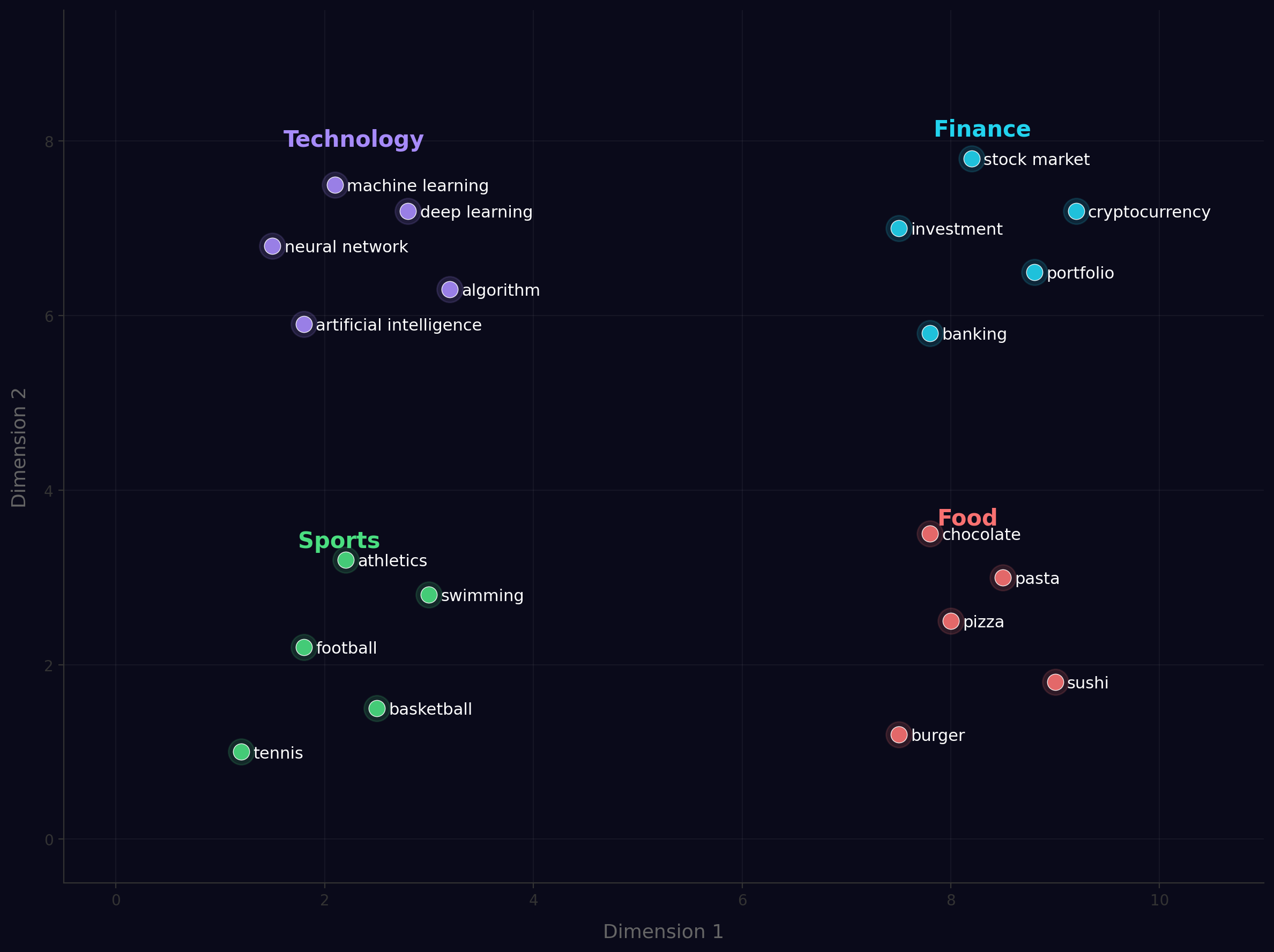
High-dimensional vectors projected to 2D. Related terms naturally cluster together.
Distance Metrics — How to Measure Similarity
We have vectors. Now how do we compare them? There are 3 main options:
Measures the angle between vectors. Ignores vector length — only cares about direction. Default for most embedding models.
Sensitive to vector magnitude. Longer vectors score higher. Use when length = importance.
L2 distance in vector space. Smaller = more similar (opposite direction from cosine).
Cosine Similarity — What the Scores Mean
We chose cosine. But what does a score of 0.85 actually mean?
0.90+
Near-duplicate
"car" ↔ "automobile"
0.70–0.90
Same topic
"machine learning" ↔ "deep learning"
0.40–0.70
Loosely related
"machine learning" ↔ "stock market"
< 0.40
Unrelated
"car" ↔ "pizza"
Embedding Models Landscape
| Model | Dimensions | Languages | Best for |
|---|---|---|---|
| all-MiniLM-L6-v2 | 384 | English | Fast, lightweight, English-only tasks |
| multilingual-MiniLM | 384 | 50+ languages | Multilingual, runs locally ✅ |
| BGE-M3 | 1024 | 100+ languages | State-of-the-art multilingual |
| text-embedding-3-large | 3072 | Multilingual | OpenAI API (highest quality) |
paraphrase-multilingual-MiniLM-L12-v2 — it runs locally, supports 50+ languages, and is fast on CPU.Why Dimensions Matter
Lower dimensions (e.g. 384)
- Faster to compute
- Less storage needed
- Good for most tasks
- May lose fine-grained distinctions
Higher dimensions (e.g. 3072)
- Captures subtle differences
- Better for specialized domains
- Slower and more expensive
- Needs more training data to fill
Think of it like resolution: 384-dim = "720p", 3072-dim = "4K" — more detail, but more cost.
Section 3 of 3
Multilingual &
Domain Alignment
When your data doesn't speak English
Cross-Lingual Alignment
Multilingual models map different languages into a shared vector space
"heart failure" (English)
≈ same vector as ≈
"insufficienza cardiaca" (Italian)
✅ Multilingual Models
- One model handles many languages
- Cross-lingual search works
- Good for mixed-language data
⚠️ Translation Pipeline
- Translate to English first
- Use English-only model
- Adds latency + translation errors
Domain-Specific Challenges
The Problem
General models are trained on Wikipedia, news, books — not on your domain's jargon.
General Model
"ERP" and "SAP" → low similarity 😕
(doesn't know they're related enterprise systems)
Domain-Adapted Model
"ERP" and "SAP" → high similarity ✅
(trained on enterprise data, knows the relationship)
Practical Guidance
Which model should you use?
| Scenario | Recommended Model | Why |
|---|---|---|
| English-only, fast prototyping | all-MiniLM-L6-v2 |
Fast, lightweight, good enough |
| Multilingual content | multilingual-MiniLM |
50+ languages, runs locally |
| Production, high accuracy | BGE-M3 or OpenAI |
State-of-the-art quality |
| Specialized domain | Fine-tuned model | Trained on your data (Lecture 9) |
Why This Matters for Your Work
- Embeddings power search — find relevant documents by meaning, not just keywords. This is the core of Lectures 3–8.
- Tokenization drives cost — understanding how your text gets tokenized helps you optimize API spend and design better prompts.
- Model choice is a daily decision — multilingual vs. English-only, small vs. large, local vs. cloud. You'll make this call on every project.
- "LLMs predict, they don't know" — this mental model prevents you from trusting LLMs with tasks they can't handle (math, fresh facts, guaranteed correctness).
Everything from Lecture 2 onward builds on these fundamentals.
Prompting, RAG, Agents, Fine-Tuning — they all depend on embeddings and understanding how LLMs work.
🔬 Hands-on Lab
Embeddings Exploration
Let’s see everything we learned — step by step in Colab
Open Google Colab → run all cells step by step
lab_01_embeddings.ipynb
Lecture 2 — Key Takeaways
- Transformers process all tokens in parallel using self-attention — this is what made modern AI possible
- LLMs are next-token predictors — they don't "understand", they predict
- Tokenization is the invisible bottleneck — non-English text costs more tokens
- Embeddings map text to vectors — similar meanings = similar directions
- Cosine similarity measures semantic closeness in vector space
- Use multilingual models for non-English data, not English-only models
Next lecture → Lecture 3: Prompt Engineering
How to communicate effectively with LLMs
Questions?
Repository: github.com/KamyarZeinalipour/zucchetti-llm-course
Lecture 2 of 10 · Zucchetti LLM Course